Leaves Seamless Patterns 04: A Practical Guide to Choosing and Using Nature-Inspired Design Assets
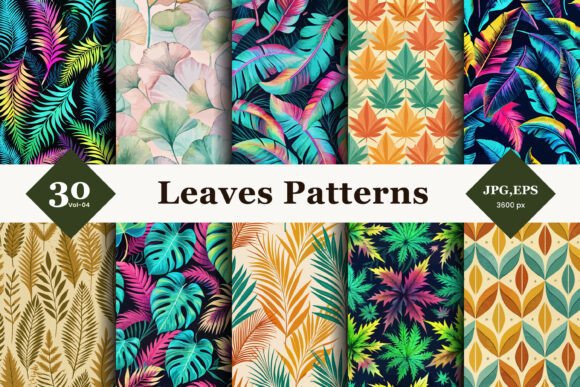
When you are looking for design assets that bridge the gap between organic beauty and professional polish, Leaves Seamless Patterns 04 stands out as a versatile resource. This collection is not just another bundle of generic clip art; it represents a curated blend of nature-inspired motifs designed for creators who demand both aesthetic elegance and technical reliability. From soft watercolor leaves to bold tropical foliage and detailed autumn botanicals, this pack offers a rich visual vocabulary that can elevate everything from digital wallpapers to physical fabric prints.
However, simply downloading a pattern pack is only the first step. Many designers, particularly those new to commercial licensing or high-resolution printing, make critical errors in how they evaluate and apply these assets. These mistakes can lead to pixelated outputs, licensing disputes, or designs that feel disjointed rather than cohesive. By understanding the specific features of Leaves Seamless Patterns 04—such as its inclusion of both high-resolution JPGs and fully editable EPS files—you can avoid common pitfalls and maximize the value of your creative projects.
Understanding the Dual-Format Advantage
One of the most significant selling points of Leaves Seamless Patterns 04 is its dual-format structure. You receive high-resolution JPG files at 300 DPI alongside fully editable EPS vector files. While many users immediately gravitate toward the JPGs for their ease of use, overlooking the potential of the EPS vectors is a common oversight that limits the longevity and versatility of your work.
JPG files are raster-based images. They are excellent for quick mockups, web graphics, and direct printing if the dimensions match your needs. At 300 DPI, they offer sufficient clarity for standard print sizes. However, if you attempt to scale a JPG beyond its original resolution, you will encounter pixelation, which ruins the clean, elegant look that natural patterns provide.
EPS files, on the other hand, are vector-based. This means they are defined by mathematical equations rather than pixels. The primary benefit here is unlimited resizing without any loss of quality. If you are designing a large-scale wallpaper, a billboard, or a textile pattern that needs to be repeated seamlessly across yards of fabric, the EPS files are indispensable. They allow you to adjust colors, modify individual leaf shapes, and integrate the patterns into larger compositions with precision. Ignoring the vector files essentially caps the potential applications of your purchase.
Avoiding Common Mistakes in Pattern Application
Even with high-quality assets like Leaves Seamless Patterns 04, the final result depends heavily on how you apply them. Here are several frequent errors that can compromise your project’s quality, along with practical advice on how to correct them.
1. Ignoring Seamless Tiling Requirements
The term "seamless" implies that the pattern repeats perfectly without visible seams or gaps. A common mistake is assuming that any nature-themed image can be tiled indefinitely. While Leaves Seamless Patterns 04 is designed for seamless tiling, improper setup in your design software can break this illusion. For instance, failing to set the correct canvas size relative to the pattern tile size can result in awkward cuts at the edges of your design.
Better Approach: Always check the tile dimensions provided with the asset. In software like Adobe Illustrator or Photoshop, use the "Define Pattern" feature carefully. When applying the pattern to a background, ensure the layer is scaled proportionally so that the repetition aligns naturally. Test the tile by repeating it four times in a row and checking for discontinuities.
2. Overlooking Color Profile Discrepancies
Digital screens and physical printers operate on different color models: RGB (Red, Green, Blue) for screens and CMYK (Cyan, Magenta, Yellow, Key/Black) for print. Leaves Seamless Patterns 04 likely provides files optimized for one or both. If you download an RGB JPG intended for web use and send it directly to a printer expecting vibrant, saturated colors, the result may appear dull or washed out.
Better Approach: Verify the color profile before starting your project. If you are creating digital content for social media or websites, stick to the RGB versions. For sublimation, greeting cards, or fabric design, convert your files to CMYK or consult your printer’s specific requirements. Some packs include both profiles; if not, perform a test print to see how the colors translate.
3. Misjudging Scale and Density
Nature-inspired motifs vary significantly in density. Some patterns in Leaves Seamless Patterns 04 may feature sparse, delicate watercolor leaves, while others boast dense, bold tropical foliage. A frequent error is using a dense pattern as a subtle background texture or a sparse pattern as a dominant foreground element, leading to visual imbalance.
Better Approach: Consider the hierarchy of your design. Use denser patterns for focal points or backgrounds where you want to create depth and atmosphere. Reserve lighter, more open patterns for borders, headers, or areas where text needs to remain legible. Experiment with opacity levels; reducing the opacity of a bold tropical pattern can turn it into a sophisticated watermark, adding style without overwhelming the viewer.
Evaluating Usability for Specific Projects
Leaves Seamless Patterns 04 is marketed towards a wide audience, including freelancers, small business owners, and hobbyists. To get the most out of this pack, it is crucial to align the asset’s capabilities with your specific output method.
- Sublimation and Fabric Design: The high-resolution JPGs are ideal for direct upload to sublimation printers. Ensure your fabric choice complements the ink absorption properties of the pattern. The seamless nature of the EPS files allows you to create custom repeat layouts that fit specific garment measurements precisely.
- Wallpapers and Digital Backdrops: For desktop or mobile wallpapers, the 300 DPI JPGs provide sharp detail. However, remember that screen resolutions vary. Test your pattern on actual devices to ensure it looks crisp on both high-DPI Retina displays and standard monitors.
- Greeting Cards and Scrapbooking: Print quality is paramount here. Use the EPS files to ensure that fine details in the watercolor textures do not blur when printed on cardstock. The vector format also allows you to crop specific leaf clusters for smaller embellishments, giving you greater control over the layout.
Final Checks Before You Create
Before diving into your next project with Leaves Seamless Patterns 04, take a moment to review your workflow. Confirm that you have downloaded both the JPG and EPS files, as relying solely on one format limits your flexibility. Check the licensing terms to ensure your intended use—whether personal, educational, or commercial—is covered. Finally, organize your assets logically. Naming your files clearly (e.g., "Leaves_Watercolor_Seamless_01.jpg") will save you time during the creative process and prevent confusion when managing multiple projects.
By approaching Leaves Seamless Patterns 04 with an understanding of its technical strengths and potential application challenges, you can produce designs that are not only visually stunning but also professionally executed. The key lies in respecting the medium, whether it is the infinite scalability of vectors or the vibrant saturation of high-resolution rasters. With careful planning and attention to detail, these nature-inspired motifs can become a cornerstone of your design portfolio, offering endless possibilities for elegant, organic expression.